
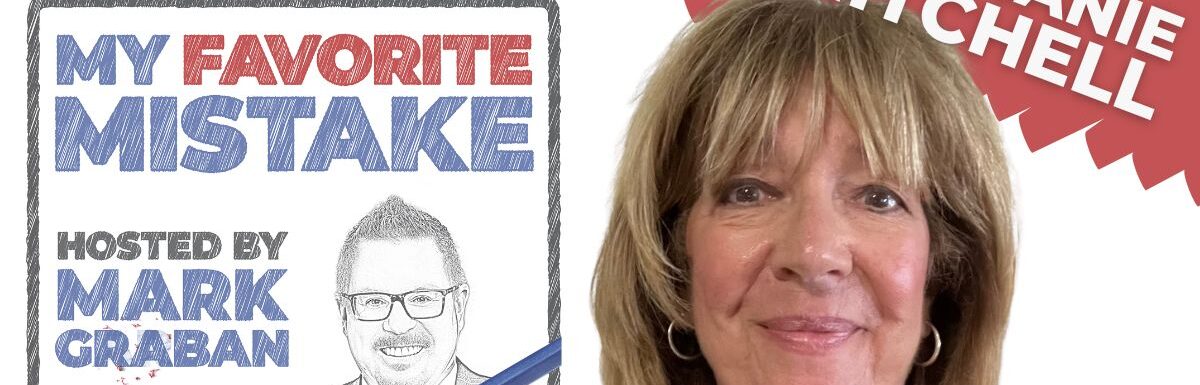
Stephanie Mitchell was an ICU nurse who had moved into hospital administration when the C-suite called her in and asked her to take over the laboratory temporarily — a department she knew nothing about, at a moment when outside consultants were arriving to cut costs. She said yes. Then she spent four months working night and day while lab staff wondered what a nurse was doing there, and more than once thought: I shouldn't have said yes.
Listen:
Check out all episodes on the My Favorite Mistake main page.
My guest for Episode #367 of the My Favorite Mistake podcast is Stephanie Mitchell, RN, BSN, MBA, who retired as Director of Lean Process Improvement and Laboratory Services at Riverside Medical Center in Kankakee, Illinois. We met about 20 years ago, when I was consulting with a Johnson & Johnson group that did Lean work in hospital laboratories and Stephanie was the client.
Her favorite mistake was saying yes. She came back from vacation, got called into the C-suite, and was asked to take the laboratory director job temporarily. Her background was ICU nursing, not the lab. They wanted her because she had administrative experience and because outside consultants were arriving to cut costs. She took it, and asked to be let out of it as soon as she could.
The next four months were worse than she expected. The staff knew what the consultants were there to do, and a nurse running the lab did not help. She worked night and day and more than once thought she had made a mistake in accepting. What changed her mind was learning what the work actually was. She had assumed lab staff sat waiting for her phone calls. They did not. By the end of the four months she wanted to stay and fix the processes she had come to understand, so she asked to interview for the permanent job she had been trying to escape. She got it, and retired from that lab 20 years later.
We also get into what separates cutting costs the right way from telling a department to find 10 percent and figure it out, why Johnson & Johnson would not take a hospital as a client unless it committed in writing to no layoffs from productivity gains, how faster lab turnaround times helped Riverside avoid building an emergency department expansion, the layered checks that make it nearly impossible to transfuse the wrong unit of blood, and what David Mann meant by embracing a mistake instead of looking away from it.
What You'll Learn
- Why being handed a department you do not understand can make you a better leader of it, and what has to change in how you lead
- What separates real cost reduction from an across-the-board 10 percent cut handed down without data
- Why she told the CEO he could fire her if Lean did not work, and whether she would say it again
- How a no-layoff commitment made improvement possible, and why one consulting group put it in the contract
- Why faster turnaround times were a patient care issue before they were a financial one
- How the blood bank built five separate checks so that no single human error could give a patient the wrong unit
- Why the people who never ask questions worried her more than the people who did
Scroll down to find:
- Video version of the episode
- How to subscribe
- Quotes
- Full transcript
Find Stephanie on social media:
Watch the Episode:
Memorable Moments from the Conversation:
Click on an image for a larger view
Subscribe, Follow, Support, Rate, and Review!
Please follow, rate, and review via Apple Podcasts, Podchaser, or your favorite app—that helps others find this content, and you'll be sure to get future episodes as they are released.
Don't miss an episode! You can sign up to receive new episodes via email.
This podcast is part of the Lean Communicators network.

Other Ways to Subscribe or Follow — Apps & Email
Episode #367: Stephanie Mitchell, Retired Laboratory Director
Meeting Twenty Years Ago at Riverside
Mark Graban: Hi, welcome to My Favorite Mistake. I'm your host, Mark Graban. Our guest today is Stephanie Mitchell. She is the retired director of laboratory services. She worked at Riverside Medical Center in Kankakee, Illinois, which is south of Chicago. Her background professionally: she is an RN, she's a BSN, she has an MBA. We first met when she was a client when I worked for a group within Johnson & Johnson called Valumetrics that did consulting work with hospitals. Can you believe it, Stephanie? It was just over 20 years ago.
Stephanie Mitchell: I know. Time has just been flying by. I remember it because my first grandson was born at the time we started.
Mark Graban: Yes.
Stephanie Mitchell: Remember? That's right. So I know how many years exactly.
Mark Graban: When I started working with KaiNexus, the software company, our co-founder and CEO Greg Jacobson and his wife had a baby right about two weeks after I started. So there's something to be said for keeping track of how long you've known and worked with somebody. We haven't worked together those entire 20 years, but I'm glad we've kept in touch, and I'm glad you could join us here, Stephanie.
Stephanie Mitchell: Me too. I'm excited.
Mark Graban: There are things we're going to talk about when it comes to improvement and leadership and different things that you've done. I know you've kept in touch with the hospital and the lab after you retired, so we'll come back and talk about a lot of that. But I know you're prepared for the question we always start off with here. Stephanie, what's your favorite mistake?
Saying Yes to a Lab She Knew Nothing About
Stephanie Mitchell: My favorite mistake was when I started in the laboratory. I had just come back from vacation, and I was called into the C-suite. They asked me if I would take over temporarily, a temporary position as director of the laboratory. I was asking why. “Why me? I don't know anything about the laboratory.” But they needed somebody with administration experience because they had consultants coming in. So I told them I would do it, but I would like to get out of it as soon as I could.
Mark Graban: And this was consultants, sorry to interrupt, other consultants. This was not yet me and our colleague, my friend Shana, and J&J. This was a couple of years before that, right?
Stephanie Mitchell: This was probably about five years prior to that, because we ended up really having good consultants that did things well. We worked hard at doing things like taking phone calls and getting data, which we did not have prior to this. Some of the other areas didn't have the experience I did. I had somebody to work with that was really good. It was over a four-month period, and I worked night and day pouring my heart into this, because I knew we had to cut costs, and that's really what they were there for.
But we did it the right way. In the middle of that, being a nurse, it was very difficult to go in there when all the staff knew that we were there to cut costs. And being a nurse, they think, “What's a nurse doing in here? They don't know anything about the laboratory.” So it was really very hard, and there were times where I thought, “What have I done? I made a mistake. I shouldn't have said yes.”
However, at the end of it all, which was about a four-month period, I had learned a lot about processes in the lab, and my preconceived opinion about laboratory was a lot different than what it really is. I thought there were laboratory staff that were just sitting down there waiting, as a nurse, waiting for my call to ask them for lab results. That's not the case. And many other things. So I realized that what I thought was a mistake being there, I really wanted to stay and help fix some of the things and the processes that I had learned about. So I asked to interview. They said, “Yes, but we told you this is temporary.” And I said, “That's okay, just let me interview.” And I interviewed, and I got the position. So as a mistake, at first I thought it was a mistake, but I ended up 20 years later retiring from the lab, and I loved it. So pretty good outcome.
Mark Graban: Well, I'm glad there was a good outcome. I'm glad you stuck with it. There was a lot between here and the there 20 years later for you. But can you set a little more context? Because I think people might not realize, if they work in businesses where people get moved into different areas. Somebody who started in HR might get moved into a procurement leadership role. This is how a lot of companies develop people, is moving you into different areas. It's fair to say in healthcare that tends to stay within your professional silo, right? Nurses become nursing leaders, laboratory technologists become laboratory leaders. Tell us more about that, and even how you experienced that in nursing.
Leading People Who Know More Than You
Stephanie Mitchell: That's definitely the case in nursing, and it was very rare that a nurse would be over the laboratory. I had worked in several different positions. I was ICU background. There was also always nursing leadership in the roles that I had been in. Even when I went to the lab, I wondered why. I knew that I needed to be there, and I knew they needed somebody with administrative experience. But I'm asking, “How do I know that I can do this position?”
And they said, “You really do. You know the doctors. You know the nurses from the nurses' side of it. You don't need to be an expert in the areas,” because we had experts in each of the areas, like the blood bank, hematology. Everybody has an expert team leader over that area. That wasn't what I was there to do, and I realized that in the position that they wanted me in, I had a background that would help the laboratory. I've worked on the other side of the fence, and I know what doctors expect, and I know what the nurses expect. So I felt like I'd be an attribute at the time. It was challenging, to say the least, and the staff weren't always that positive about having a nurse there. But it worked out, because then it gave them… I mean, I had to ask their opinion. I didn't know it. I didn't know what they did. I wasn't clinically capable. I had chemistry. I had a lot of science background, but I didn't know their jobs like they did.
Mark Graban: You weren't going to jump in and start slicing specimens for slides in histology or streaking plates in microbiology, and you couldn't tell people how to do that. I think that's the fascinating leadership challenge: instead of needing to have all the answers and telling people what to do, you can set direction, you can lead, you can work together with people. You can ask questions, and maybe that leads to some insights that people hadn't thought about before. But it's a different style of leadership.
Stephanie Mitchell: That almost came about naturally because of the position I was in, and that's probably what was very helpful about it. I had the expertise of the medical director and the pathologists, so if I had questions about clinically what was going on, I could go to them for their expertise also. That helped. But I really needed to rely on the expertise of the people that were in the lab. So it lended itself for their participation. We needed their participation and decision-making, because I didn't have the clinical background for that.
Mark Graban: Compare that to your time in nursing roles. I never saw you being a nursing leader. Was that already a bit of how you operated? You never struck me as the type that was going to have all the answers even if you knew the clinical work involved, that you were going to engage people. That, to me, seemed your style. Maybe you had already adapted by the time I met you.
Stephanie Mitchell: I had to learn. When I first started out, I thought I was going to be on a med-surg floor, and they said, “No, we need you in ICU,” as a new grad, and that's a real challenge to say the least. When I got into a leadership role, I had to really depend on people. I'd moved to different departments. I've worked in cardiac rehab, where they combined respiratory rehab and cardiac rehab. I don't know too much about respiratory rehab, so I had to rely on the people with that expertise. And in other areas too. I was over cardiology for a while, and you have to rely on the experts that know how to do a cardiac cath. I didn't know how to do that.
So I think I didn't realize that was what I had to do, but I did, because of the positions that I was in. And in nursing, believe me, there's so many things that you need to know that you have to rely on experts in their fields. You don't know it all. You have to ask questions. To me, the scary thing was people that didn't ask questions and didn't admit they didn't know it.
Mark Graban: People at different points you worked for, you mean, without naming names?
Stephanie Mitchell: Yes. You need to ask questions. When you thought you knew it all, that was scary to me, because you know they didn't. And they needed the help of others to do those things.
Stephanie Mitchell: So I think I naturally probably was that way. And I was in several different positions. I worked over skilled nursing at one time period, and I didn't know anything about long-term care or skilled nursing either. So I had to rely on good leaders. But luckily where I worked, I trusted the system. I loved where I worked. I loved the people that I worked with. We had good leaders and good personnel to work with. Not all of the time, but you had to rely on them. So it came naturally, I guess.
Cutting Costs the Right Way
Mark Graban: One other thing I wanted to go back to, and maybe some of this will be a transition into talking about the Lean transformation of the laboratory that you were leading and I was involved in. And again, I'll give credit to Shana Padgett, who's now the CEO at Value Capture. First off, you said earlier about this idea of cutting costs the right way. Could you tell us more about that? What, in your view, would the wrong way be, and what was that right way cost-cutting process?
Stephanie Mitchell: The wrong way is how some of the departments had to go through that. They were told that they just needed to cut off the bat 10 percent. They were cutting it at 10 percent, you figure it out. And they really didn't know what they were doing. They just cut 10 percent and had no idea where, didn't have data, didn't have any background into the processes that were going on. That's the wrong way.
The right way, first of all, with the consultants that we had in the very beginning before you came, was to get the data. We didn't have Epic back then. We didn't have a way to get good data, so we did it ourselves. We taped phone calls. We really got data, and we really looked at the skill mix of the staff. Is this med tech doing work that really somebody else could do? So we looked at the skill set of the people and tried to work with that. That's what I call the right way of doing it, and looking at processes.
And then when we went to Lean, that's exactly the right way to do it, because we had data, and we watched people doing their work, and we had experts in their areas involved on the teams. That's the right way. The wrong way is just cut and that's it. Just live with it. And that just doesn't work sometimes, or it doesn't stay. It doesn't stick.
Mark Graban: I don't know if it ever works, or if it works, it can be counterproductive, because I've worked with hospitals in different places where there had been a cost-cutting initiative that was very much driven by spreadsheets and benchmarking. It's important to look at things like… what was it? I think I heard the acronym first from you, WHOKAS.
Stephanie Mitchell: Oh, yes. Worked hours per unit of service.
Mark Graban: Worked hours per unit of service. When I was in manufacturing, ratios like this are important. But it can be hard to make comparisons across different labs when different labs might have more efficiency built in when it comes to the equipment and the layout and the processes compared to another. So as you were saying, looking at the process of figuring out how many people does it really take to do the right work the right way. And then if you find there's a mismatch, you might try to add people.
But I remember even 20 years ago, people were saying there were shortages of lab professionals, that that was going to get worse, that we had to make work easier, that we had to take time and walking and all the other time wasters out of the process so that the people there could do more without being overburdened. So that's what we were working on together, trying to figure out how do we allow people to be more efficient structurally instead of just demanding they be efficient?
Stephanie Mitchell: That's definitely the right way, which comes to mind where we redesigned the whole layout of the center core of the lab and looked at walking patterns and how redundant the walking patterns were, and the wait times, where they'd sit and wait while the analyzer was running. In that time that they were waiting, nothing was getting done, and how could we make them more productive and happier with what they were doing also. It's an employee satisfier also. That's definitely a good way to look at things. And it also reduced cost and reduced our need for employees.
The No-Layoff Commitment
Stephanie Mitchell: The other good thing that we did is when we did look at it and we didn't need as many people to do the work, we did not cut them. We did not fire them or do anything like that, and we promised them upfront, which was hard to convince them that was not going to happen. And then you had them to utilize them to look at more things, like let's look at quality or quality initiatives, or there's always processes that need improvement. That was what was so fun about the lab. There's always something that we could do better. And we could use those people to do things better. So we did not ever, and we let them know that they were not going to lose their jobs because we were more efficient. But we did really reduce the need for the people that we had.
Stephanie Mitchell: And some of it was by attrition also.
Mark Graban: People retire, people leave and move out of state, and you're right, there's attrition. But this is classic Lean advice of saying, if you want people to collaborate and participate in improvement, they can't be afraid of them or their friends and colleagues losing jobs. That no-layoffs-due-to-Lean commitment is something that a good number of hospitals committed to.
One thing I really enjoyed about working for that team at Johnson & Johnson was that it was standard for that consulting group that if the potential client would not sign up for that commitment, J&J wouldn't work with them. And it was in the contract that if you start laying off people because of productivity and improvement, we will walk away.
Stephanie Mitchell: We did not realize that.
Mark Graban: That was a real hard line, and that was meaningful for me, because to me, Lean wasn't about trying to create… People hear the word Lean and they have different impressions or perspectives, that it's going to be about layoffs, or that we're never going to have a minute to breathe because we're going to be racing around. They think of Lucy and Ethel in the chocolate factory.
Stephanie Mitchell: That's true.
Mark Graban: Right? That's the opposite of what we're trying to create. I think the day goes better when people are working at a good pace and they know they're doing so to support patients and doctors. The pace needs to be good, not standing around bored, which is one type of problem, and certainly not sweating and racing around. Trying to find that middle ground. I never found anybody, when productivity improvement was being done the right way, that really hated living through that. They might have been scared of the idea of it.
Stephanie Mitchell: And if we would see that, when we did our daily audits and looked at the process, if we would see that type of activity and it looked chaotic, we knew there was some breakdown in standard work or what they were supposed to be doing.
Mark Graban: A process problem.
Stephanie Mitchell: And that was a good thing, to identify a mistake or something we could improve, because that should not happen in that situation.
Turnaround Times and the ER Expansion They Did Not Build
Mark Graban: So beyond productivity and cost, which are of course real issues, important issues, maybe step back and think back. Help us understand what was the motivation for Lean? What were the different dimensions where the lab could perform better for the patients and for the hospital beyond productivity and cost?
Stephanie Mitchell: More motivation from things like turnaround times.
Mark Graban: Yeah, if you can explain that. Because people might not realize the idea of, they're a patient in the bed and they get their blood drawn. What happens next, and why does it take a certain amount of time for a test result to get to their doctor, to get on their chart for a doctor to read it?
Stephanie Mitchell: In the very beginning, the reason we went to Lean was the fact that we had done everything what I felt like was the right way, and I had no more ideas of things we could do to make it better. So the real reason, and I tell people this, I went to a seminar to learn about it. And when I went to the seminar, the honest truth was it was just to get out of the office for a while, because it was so intense, and I was running out of ideas.
And then when I went there, I could see the things that we could do better, and some of the things that we weren't doing well, where we didn't have standard turnaround times for our ER. So if the doctors in the ER, which is a very critical place, and in ICUs and wherever, needed their results, we couldn't even tell them what our timeframe was going to be, of when we could get those results to them. So it's really important if a patient's having a heart attack that we can turn around those results in a timely manner. And also let them know that there is a quality result that they were getting.
So complaints from physicians on turnaround times was probably the thing that was so frustrating, because we knew we needed to do it better, and we didn't know how to do it better. And I felt like we used all of our ideas in that initial visit, and now we needed to do something different. And this provided that.
Even as far as layout, the layout in the lab that we had, and the instrumentation layout, and our quality initiatives, and our numbers of draws on the floor, the phlebotomists drawing blood on the floor. We didn't know how long it took them to draw in the mornings and when we could produce a result before the physicians made rounds or whatever. So there's many ways. Blood, we needed to be able to turn around. If the ER needed blood right away, did we have a process in place to be able to get that to them in an emergent way, in a way that they could depend on the timeframe that we were going to do that? And it was very frustrating not to be able to do that. So we needed to look at what we were doing. It's for the care of the patients. And that's the main thing.
Mark Graban: The doctors might be complaining, but they're doing so on behalf of the patient, because the turnaround time can really affect length of stay. If I remember right, one of the key measures was not just reducing the amount of flow time, the amount of turnaround time, but also getting the results on the chart by the time the doctors are doing morning rounding. Because if I remember right, that could help get the patient discharged that morning instead of potentially waiting until the next day, right?
Stephanie Mitchell: Right. And even in the ER, to get those patients' results faster so they can diagnose the patients and turn around those beds faster, because the beds were crowded, and sometimes we would have so many patients that we needed to turn that around faster. And actually, as I remember now, it's been a while, but they were planning an expansion of the ED, the emergency department, and one of the main reasons that they did not have to do that, there were others also, but the main reason is because they were able to turn those patients around faster, because we were able to get them the information that they needed in a more timely manner. So they actually did not do the expansion for the ER at that time because of that. And that's important. You don't want patients going to the ER and waiting for care.
Mark Graban: And not having to pay for that expansion had a big financial impact.
Stephanie Mitchell: Oh, definitely.
Mark Graban: There's a big cost avoidance.
Stephanie Mitchell: Definitely.
Convincing a Skeptical C-Suite
Mark Graban: You talk about going to that seminar, and 2006, I would still put you and Riverside in an early adopter category at that point. Labs in general were, I think, one of the earliest adopters of the Lean methodology, because in a lot of ways it's kind of like a factory, with tubes of blood and specimens and equipment and skilled operators. I would try not to say that to the lab people, but it was more like a factory than other departments might be. At that seminar, you were hearing other lab directors that were even earlier adopters talking about what they did and what their lessons were. That probably helped you feel a little more confident that you weren't making a mistake starting this Lean initiative, or that you weren't making a mistake bringing in consultants. Tell us more about that.
Stephanie Mitchell: Prior to having you guys there, we did research. I learned a lot and I got excited, because I thought now there's something that we can do, and this isn't hard. This is just going to take work and a lot of involvement by everybody, and commitment. We did research different consultants, and one of the early adopters was somebody in Florida. I don't remember who they were, but I remember they had had some Lean initiatives that were very positive and they were able to sustain it, and that was the other thing I was looking for. There weren't a lot of places that had sustainability, that even after these projects, could they sustain what they implemented?
So after doing a lot of research, I went to the C-suite and did a presentation on it and said, “I think this is going to be great. We need to do this.” And they were hesitant. They said, “Go back, get more information.” Did that. And then I think it took about three presentations. I told them, “I am so sold on this, and I feel so positive because I have seen other leaders and they have the same problems we do. They have that pillar in the middle of the lab that you can't move, that column that supports the building.” We had all the same issues. It's just how we addressed it. So I felt very positive that we could do it.
And I actually remember Phil telling me this. I don't remember saying any of it, but…
Mark Graban: Phil, the CEO, for people.
Stephanie Mitchell: He told me, the CEO, sorry, yes. He said I went to him and said, “I am so sure about this, that if it does not work, you can fire me.” Now, I don't think that was the smartest thing to say, but he said I said that. And it worked out. I know they were skeptical in the very beginning.
Mark Graban: You've told me that before. I don't remember at the time if I realized your job was on the line.
Stephanie Mitchell: Well, I don't think they ever… It was not, they didn't say that, and I had been a fairly long-term employee at that point. It was just I wanted to let them know how committed I was to it and how I felt. When you feel like you have something really good, and this is a real game changer, you know it's good, and you've got to convince people, and I felt like this is one of those things that we just can't let go. This is going to be good. And it's going to be good for a long time, and it's going to be good for patients and patient care and the employees. I had that great feeling, and I was so sold on it that I said, “Trust me. Trust me, it's good.”
Stephanie Mitchell: And they did.
Building the Lean Team, and Living Through the Intensity
Mark Graban: And things worked out. There was a lot of work, and a lot of that work was done. I wanted to bring up one part of the approach, and I'll tell it from my perspective as the consultant, and I want to hear your view on it, of course. When you talk about this idea of the need for sustainability, that was important to us as consultants. That's still important to me today. You don't want to fall into the trap of coming in and being some sort of outside expert who tells people what to do. And you might be technically correct, but then you leave and it would be so understandable that people would go back to their old way of doing things.
There's an expression I've learned along the way, I think it's Meg Wheatley that I can cite on this: “People own what they create.” So I think part of the way of planning for sustainability was that we did, as part of our standard approach, put together a Lean team in the laboratory. It was a mix of people from different clinical areas, and we had one of the lead phlebotomists, and there was a woman from pharmacy, to be fresh eyes, because eventually there was Lean work in the pharmacy that she was a part of. Tell us what your view was on that team. You pulled people out of their daily work for something like 12, 16 weeks.
Stephanie Mitchell: Oh, it was a long time. My view on the team: I knew why we had a mixed skill mix in there. We had people that were very analytical and very detailed, and we had a little bit of everybody in there, which I felt was a really good mixture. My real confidence was the team, because I know they were committed. They knew that they had to commit to the time, and I knew that they were. And also to you and your leadership, because I really had trust in the fact that this was going to work because of what I'd heard. So it was trust in both, really.
And there were times where, honestly, when I say mistakes, when you were there it was very intense. There were times where there was so much change, and it happened so fast, and it was very intense, that I just said, “Have I made a mistake? I just wish it was over. I want to go back to the…” It was very temporary, but I'm glad we never did. It was just a quick whatever.
But the team was very dedicated. And to have somebody there from pharmacy, we did that intentionally, because then their next project or plan was to go to pharmacy, which was another successful project. They worked hard. It was day and night, and very committed to it.
Mark Graban: One thing that was unique about that project, again, I mentioned Shana and I give her credit, that we were co-leading that project. We were both very new to J&J. We had shadowed and watched someone else do work at another lab. And then normally that J&J model was one consultant with the Lean team and with leaders like yourself and leaders at other levels, kind of figuring this out together.
Shana and I were both new. We were put into that, where Shana's background was she was a medical technologist, and she had been involved with Lean in hospital labs before. If she needed to, she could have done some of the clinical jobs in that lab, and she certainly had a deep understanding of all of that. Here I'm coming in as the engineer who is kind of like you, except I don't have any clinical background. I think that was a great learning opportunity for the both of us, to learn from each other. And that was scary for me, I'll admit, coming in. It would have been a lot scarier without somebody like Shana helping me learn and working on that together.
Stephanie Mitchell: You would never know that. You did not seem scared at all.
Mark Graban: I was scared.
Stephanie Mitchell: To say the least.
Mistake-Proofing the Blood Bank
Mark Graban: It's meaningful work, and earlier you mentioned quality and safety. The last thing any of us want to be accused of or involved in is people saying, “You're speeding things up, but it's going to hurt quality.” Well, no. When you improve the process, they go hand in hand, and you put in mistake proofing, and you're preventing mistakes while you're making things more efficient. So I was going to turn it to you as a question, in the blood bank in particular, which was some later Lean work. If you can talk about not just the turnaround time but the real implication, like a mistake could be fatal in that sort of environment, right?
Stephanie Mitchell: That's where everybody's… When you make a mistake, people don't intentionally want to make a mistake. It happens. We're human. But because there's such a severe consequence to that, and yes, people can die if they get the wrong unit of blood, we had to actually try to look at the process and ahead of time think of every possible look along the way to see what could possibly go wrong, and then mistake-proof that.
So we built in processes of check and double-check, and actually I think at one time we had five different methods. You'd have to break five different processes to give the wrong person the wrong unit of blood. So that just can't happen. So we really had to identify, and actually do it proactively. We weren't going to wait for a mistake to happen. We had to look at where they could potentially occur, and the blood bank is probably one of the more serious places that could occur. Plus they need an environment of calm. When something's going down, when somebody's bleeding out, you need calm. Things need to be working right. They needed to look at their processes and make sure everything was good that they were doing. And they didn't have to go looking for different things to do what they needed to do. We needed to have it right there in front of them, what they needed. Which is part of Lean. You tape around certain things so that they don't get picked up and moved somewhere else or whatever. And that's what we did in every department, and in the blood bank also.
Mark Graban: There are rare but serious errors in hospitals around the world where the wrong blood type, a mismatched type, is transfused into a patient. Or in the realm of anatomic pathology or histology where there's still, sadly, articles… I've been reading articles like this for 20 years now, where the wrong slice of a patient's specimen gets put on a slide that's labeled for a different patient.
Stephanie Mitchell: Mm-hmm.
Mark Graban: And then you have two patients being impacted. One being told incorrectly, “You've got cancer,” and they might get aggressive treatment or a surgery, to then learn, well, I guess the good news is you didn't have cancer to begin with. But then there's the delayed care of that person that got the incorrect diagnosis in the other direction. So there are serious stakes. I've climbed up on a soapbox about that as the engineer. I should ask you again as the laboratorian, more thoughts around the importance of trying to put a good process in place instead of just telling people to be careful.
Stephanie Mitchell: It's human error. Everybody can make human error, or has the potential for human error. Processes are never going to go just as planned, and so you just have to be proactive. And I actually had a family member that had a typo. They typed the grade of what they had as a three instead of a two, which was a worse diagnosis, and it was just a typo error that caused a surgery. So it's everywhere that you just have to watch and look.
And in a lab environment where you are drawing blood, you can mix up tubes. That was a big deal as far as labeling tubes. Thank goodness for Epic. When Epic came along, which is the LIS that a lot of the hospitals are using now, we could label the tubes and have the people that were drawing them label them correctly, in front of the patients, and say their name, and build in processes there so that the tubes don't sit somewhere and be labeled after the fact, and then they're labeled wrong with the wrong patient. So you have to really look at processes and what you do so that those kinds of things don't happen.
Embracing the Mistake
Mark Graban: We both had a favorite book in common, David Mann's Creating a Lean Culture. There's a phrase related to mistakes you brought up with me when we talked recently. I was going to ask you to share.
Stephanie Mitchell: That you embrace the mistakes? I remember him and watching him talk about this, and he stood up there and he cuddled the mistakes and said, “You need to embrace the mistake.” And I did learn that from Lean. When you look at the mistakes and you embrace it, yes, the mistake happened, but if you just didn't pay any attention to it afterwards, that's bad. You need to look at it as a positive. It's not something you want to happen. But you have an opportunity to see what that mistake was, and then figure out how that's not going to happen again.
So I even do it in my day-to-day life now. I make mistakes with some different things, and instead of going, “Oh my gosh, I made a mistake,” and feeling bad about it, yeah, you don't want to make the mistake, but yet it's an opportunity for me not to do that same thing over again. I craft a lot.
Mark Graban: So it's in crafting. What kind of crafting? I was hoping you were going to talk about this a little bit.
Stephanie Mitchell: Oh, I love it. My mother died a few years ago and left me some of her inks and alcohols and all these things that I didn't know were pigments, dyes, inks, whatever. So I started looking into what actually she had, and it was some good stuff, so I took a chemistry class online about what all these different oxides and inks are. And I make… it's more about the make. It's more the fun of making something. And I watch the videos and learn what to do.
And almost every time when I do something, not every time, but lots of times I do it wrong, but yet I don't get upset about it, because I know that I'm not going to do that again. So I just kind of plan on it. That the first one's going to be a mock-up, and then after that, then I know what I'm doing again. But it's something fun that I do. I started doing it, I retired during COVID. So it helped me get through COVID also. But mistakes now, based on David Mann, I can think of them as being positive and an opportunity.
Mark Graban: We can embrace that opportunity. We can embrace the learning opportunity. And doing anything new, being innovative, think of the stakes of making a mistake in crafting, or the stakes of making a mistake in a podcast, are very low compared to the environments you worked in, nursing and patient care and laboratory. Hopefully it's good to have less stress in your retirement, if something gets messed up, maybe it becomes an accidentally beautiful piece of art.
Stephanie Mitchell: Yes. I save it. There's something I'm going to be able to do with it. I don't know what, but I save it and look at it and know what I did. No, it's much less stressful, to say the least, compared to working in an ICU or a laboratory and making a mistake. It's a different type of a mistake, but it leaves me with, instead of that awful feeling of, “Oh, why did I do this?” it's more of a, “Okay, next time I need to remember to, or need to do something to error-proof so it doesn't happen again.”
Mark Graban: Again, our guest today, Stephanie Mitchell. Thank you for taking… You could be doing so many other things during your retirement today. Thank you for taking some time to not just reminisce, but to share. I'm glad your favorite mistake story led to something positive, and thanks for sharing some of your other lessons learned along the way.
Stephanie Mitchell: Thank you for having me. I really enjoyed it, to say the least. Thank you so much.